Vape wholesale assortment planning should answer three practical questions: which SKUs deserve shelf space, how much cash to risk on each one, and what evidence will trigger a reorder. The safest opening range is not the biggest catalog selection. It is the smallest group of clearly different products that fits the buyer’s market, budget, shelf capacity and replenishment plan.
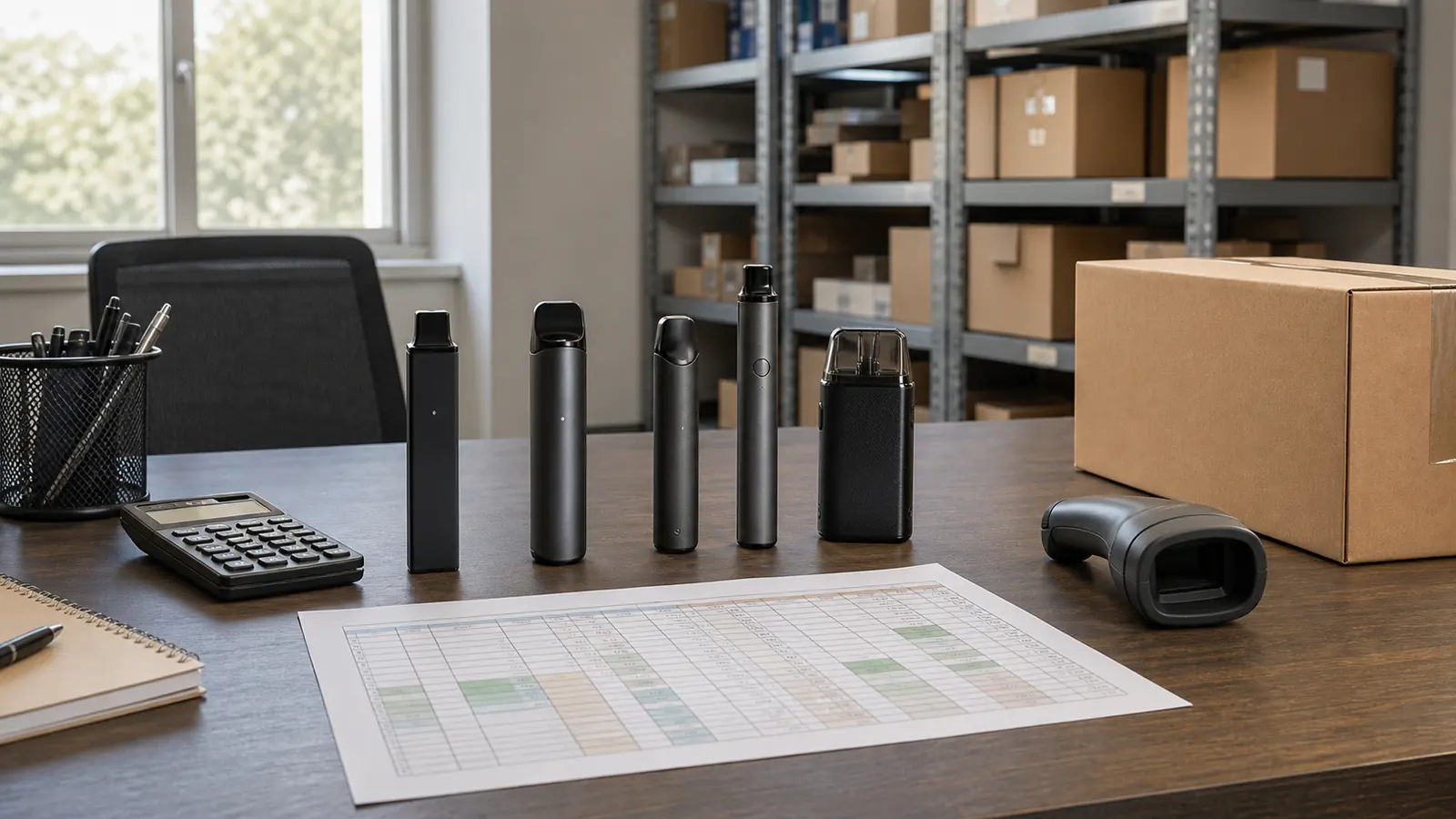
Use this rule before adding any SKU: if you cannot write its role, maximum cash exposure and reorder signal in one row, leave it out of the opening order.
Scope: this is a B2B planning method for verified adult trade buyers. The numbers in the worked example are illustrative. Current price, MOQ, stock, product evidence and destination eligibility must be confirmed for the exact order.
Elaborado y revisado por: Artifact Vapor Catalog & Documentation Team | Última revisión: 4 August 2026
Start with four limits, not a list of products
Buyers often start by opening a catalog and selecting attractive models. Reverse the process. Set the commercial limits first, then allow products to compete for a place in the range.
| Limit | Question to answer | Decision it controls |
|---|---|---|
| Merchandise budget | How much cash is available for saleable stock after freight, tax, compliance and operating reserves? | The maximum combined value of the opening order. |
| Cash cap per unproven SKU | What is the largest acceptable loss or delay on one model-flavor combination? | Whether a supplier’s MOQ is small enough to test. |
| Active shelf slots | How many SKUs can the store display, explain and count accurately? | The maximum range width. |
| Reorder window | How many days pass between placing a replenishment order and receiving saleable stock? | The stock-cover target and reorder timing. |
A fifth limit applies before all four: the exact product must pass the destination check. Use the Matriz de elegibilidad por SKU y mercado to record that decision separately from commercial scoring.
Use a two-stage SKU scorecard
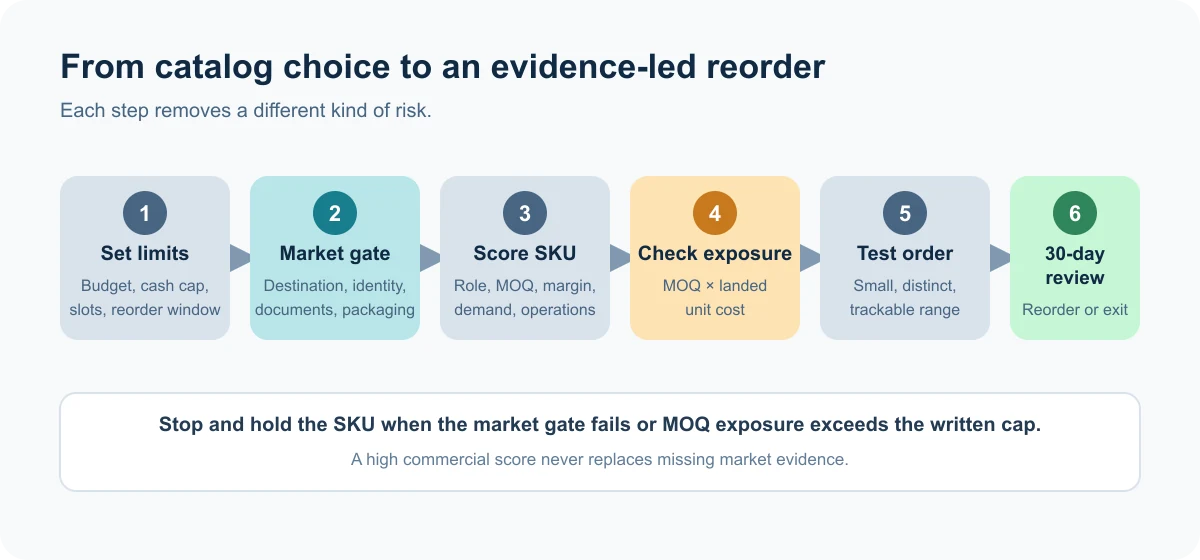
Stage 1 is a gate. Confirm the market, exact product identity, required documents and packaging or notification status. If a material field is still unknown, place the SKU on hold. Do not compensate for missing market evidence by giving the product a higher commercial score.
Stage 2 compares the products that passed. Score each factor from 0 to 2 using evidence from the buyer’s own store and the current quotation.
| Factor | 0 points | 1 point | 2 points |
|---|---|---|---|
| Distinct role | Duplicates an existing SKU | Some difference, but unclear buyer need | Fills a defined capacity, feature or customer-request role |
| MOQ fit | MOQ exceeds the SKU cash cap | Fits only with a mixed case or special term | Fits the cap under the written quotation |
| Landed margin | Below the buyer’s required margin | Meets the minimum with little buffer | Meets the target with a documented cost buffer |
| Replenishment | Lead time is unknown | Lead time is known but difficult to cover | Lead time and reorder route fit the stock plan |
| Demand evidence | No store evidence | Customer requests or limited test evidence | Repeat sell-through from the same SKU or a close predecessor |
| Operating burden | Adds excessive flavor, training or counting complexity | Manageable with changes | Fits the current shelf, staff and inventory process |
The maximum commercial score is 12. A buyer might use 8 as a test threshold, but the threshold is a company decision, not an industry rule. Keep the component scores: two products with the same total can carry very different risks.
A worked shortlist from the current catalog
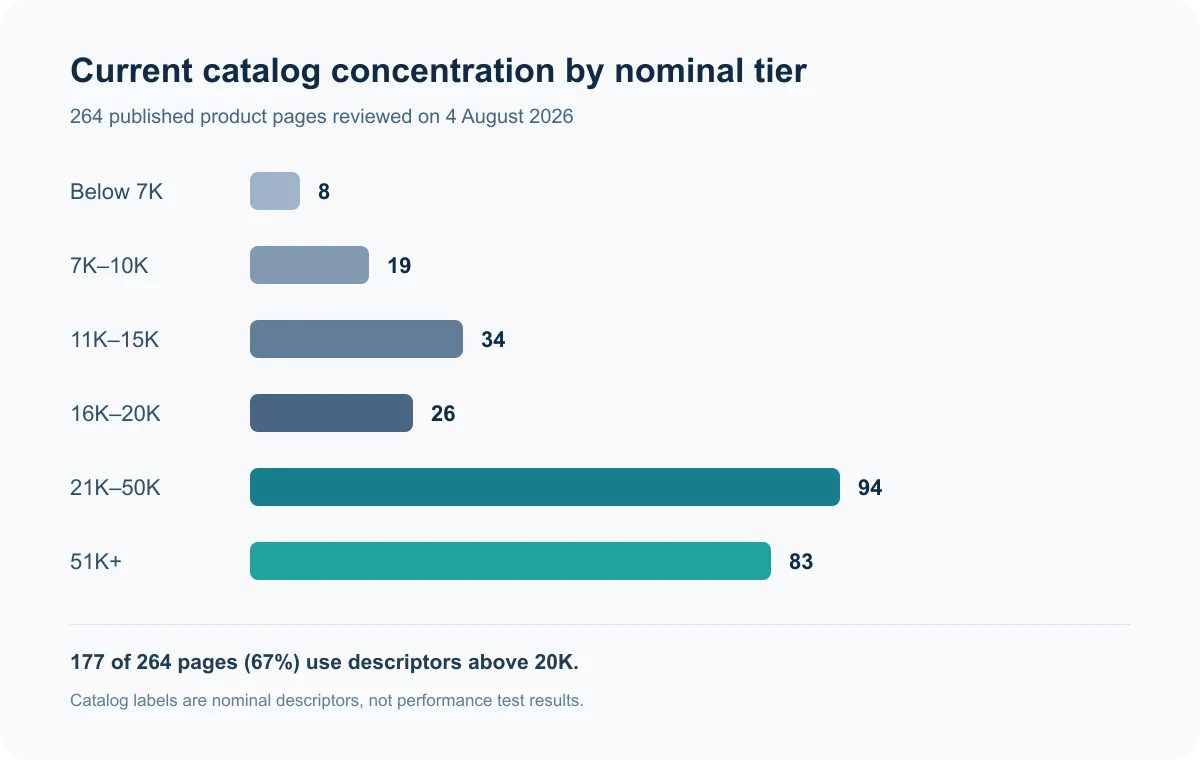
Artifact Vapor had 264 published product pages in the 4 August 2026 snapshot. Of those pages, 177 used nominal puff-count descriptors above 20K. That concentration creates a real selection problem: sorting by the highest number produces a long list of similar-looking choices instead of a useful assortment.
A buyer can reduce the first comparison to products with visibly different catalog roles:
| Example product | Possible shortlist role | What still decides the order |
|---|---|---|
| RandM Tornado 7000 | Lower nominal puff-count comparison | Requested flavor, exact configuration, MOQ, landed cost and destination status |
| WASPE Digital Box 12K | Mid-tier, display-led comparison | Feature evidence, case quantity, commercial margin and buyer demand |
| Bang Box 18K | Higher nominal tier with a display descriptor | Whether it adds a distinct role instead of duplicating the 12K option |
| Bang King 25K | High-capacity comparison | Exact option, market evidence, MOQ exposure and real sell-through after testing |
This is a shortlist, not an order recommendation. Its value is that each product has a reason to remain in the comparison. If two models end up serving the same role, keep the one with the stronger evidence and remove the duplicate before adding more flavors.
Turn the budget into an opening order
Calculate the exposure before debating flavors:
SKU cash exposure = supplier MOQ x landed cost per saleable unit.
Compare that result with the cash cap for an unproven SKU. If the exposure exceeds the cap, the model is too large for the first test unless the supplier offers a documented mixed-case option or the buyer deliberately changes the risk limit.
Illustrative example: a buyer has 12 shelf slots and a merchandise budget of EUR 6,000 after setting aside known logistics and operating reserves. The buyer caps each unproven SKU at EUR 500. A product with a 120-unit MOQ and a EUR 6 landed cost creates EUR 720 of exposure, so it fails the first test. The buyer can request a smaller or mixed case, select another product, or record a deliberate exception. Simply adding the SKU and hoping it sells is not a plan.
Normalize every quotation before using this calculation. Confirm whether MOQ applies per product, flavor or total order with the Guía sobre el pedido mínimo y la cantidad por caja. Use the landed-cost framework so freight and order-level charges are not hidden outside the comparison.
Control flavor duplication
Give every model-flavor combination its own SKU row. Add a simple flavor-family field such as fruit, ice or mint, beverage, dessert, tobacco, or shisha. These are planning labels, not claims about formulation. If the opening range already contains several products in the same family and price role, require stronger demand evidence before adding another.
Do not confuse a long flavor list with useful variety. A range becomes broader only when an added SKU serves a buyer need that the current selection does not already cover.
Use a 30-day review to decide what stays
Set the review date when the order is created. For each SKU, record:
- Sell-through: units sold divided by saleable units received.
- Weekly sales rate: units sold divided by complete selling weeks.
- Stock cover: current saleable units divided by average weekly sales.
- Return rate: returned units divided by units sold.
- Cash still tied up: current saleable units multiplied by landed unit cost.
Then assign one action: replenish, hold, reduce, investigate or discontinue. Avoid universal percentage thresholds. A new product that was out of stock for half the period cannot be compared fairly with a continuously available SKU. Preserve stockouts, promotion dates, price changes and listing problems as context.
The first order produces evidence. The second order should use it. After several review cycles, replace assumptions in the scorecard with the store’s own sales, returns and lead-time data.
Keep market updates short and operational
Europe: EU rules provide a common framework, but national controls can change the usable assortment. France has prohibited the sale and distribution of single-use electronic cigarettes since 26 February 2025, including prefilled devices that cannot be refilled even when the battery is rechargeable. Use the French Government notice and the relevant national authority before creating a country range.
Japan: on 24 July 2026, Japan’s Ministry of Health, Labour and Welfare stated that nicotine-containing electronic cigarettes are treated as unapproved drugs and that domestic sale, transfer and advertising are prohibited. Review the current ministry statement and obtain qualified advice before treating any nicotine-containing catalog item as a Japan wholesale candidate.
The action is simple: when the market evidence changes, update the eligibility gate and affected SKU rows. Do not rewrite the whole assortment plan around a headline.
Copy this worksheet structure
Create one row per model-flavor configuration with these columns:
Destination | Brand | Model | Supplier SKU | Flavor | Nominal tier | Distinct role | Market gate | MOQ | Landed unit cost | Cash exposure | Margin | Lead time | Opening units | Units sold | Returns | Current stock | Stock cover | Commercial score | Next action | Review date.
Keep the quotation, specification, packaging evidence and review source linked to the same row. The Lista de comprobación de la documentación del producto covers the related evidence fields, and the Lista de comprobación para pedidos al por mayor covers the final pre-payment review.
Preguntas frecuentes
How many SKUs should a new retailer start with?
Start with the number that fits the merchandise budget, shelf slots and per-SKU cash cap. If the buyer can manage 12 active rows accurately, a 30-SKU opening range creates complexity rather than useful choice.
Should the highest-puff products receive the most budget?
No. Nominal puff count is one catalog descriptor. Budget should follow the complete SKU score, MOQ exposure and the buyer’s own sell-through evidence.
What if the supplier MOQ is higher than the test budget?
Request a mixed case or smaller written MOQ, choose another SKU, or record a deliberate exception. Do not hide the excess by spreading the cost across unrelated products.
When should an experimental SKU be reordered?
Use the review date, sales rate, stock cover, returns, current cash exposure and replenishment lead time together. A reorder should be traceable to recorded evidence rather than a general impression that the product is popular.
Siguiente paso: select a small number of exact products from the Artifact Vapor catalog, complete one worksheet row for each option, and send the shortlist, destination and quantities through the wholesale inquiry page for current commercial information.