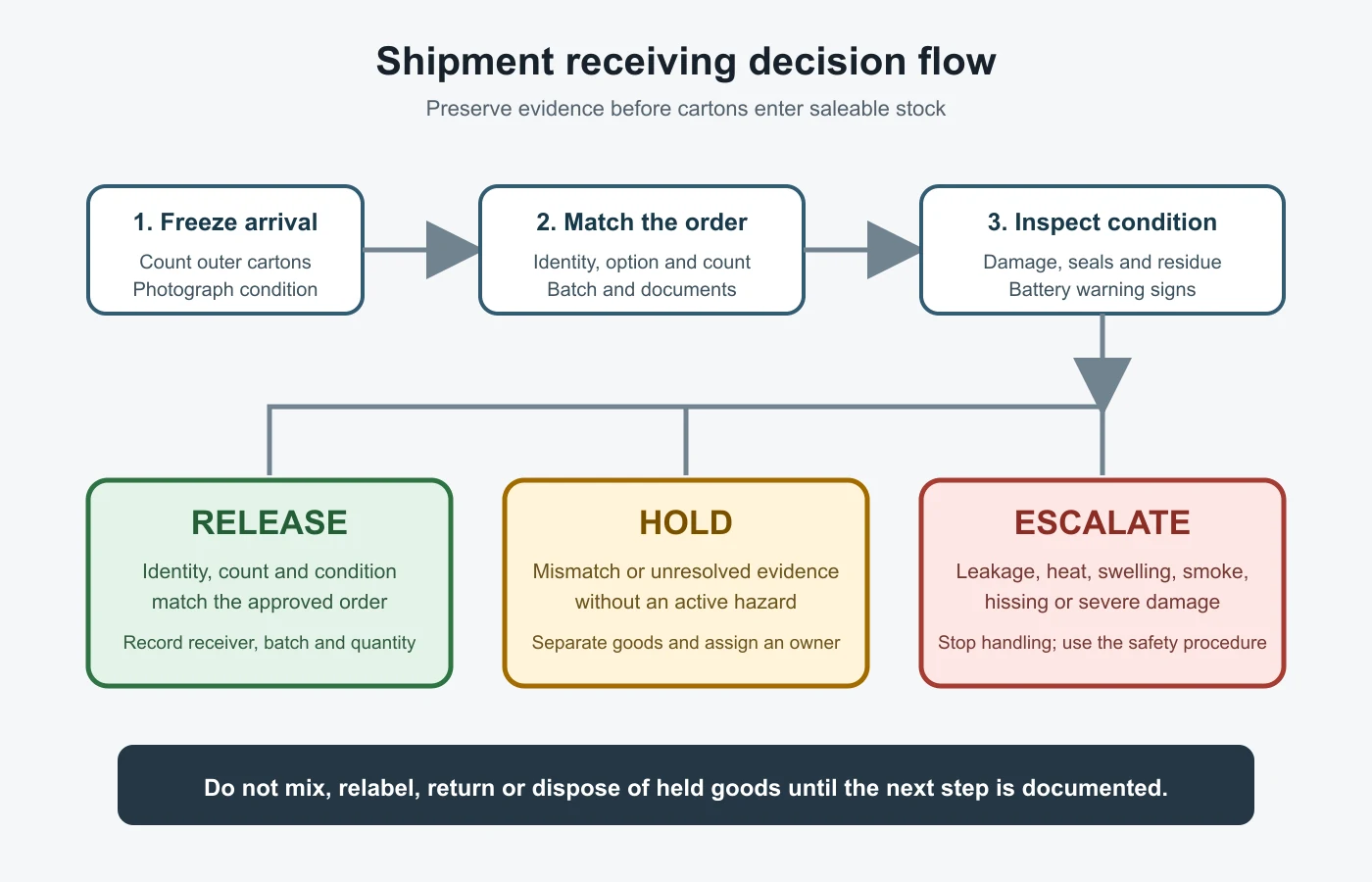
A vape shipment receiving checklist should stop cartons from entering saleable stock until the receiver has matched the delivery to the purchase record, counted the agreed commercial units, photographed the arrival condition, checked product and batch identifiers, and assigned one decision: release, hold, or escalate. The receiver does not need to prove product legality or open every unit. The immediate job is to preserve evidence, detect mismatches, and prevent an unresolved shipment from being mixed into inventory.

Scope and limitation: this is general operational information for verified adult trade buyers. It is not legal advice, a product approval, a safety certification, a carrier claim procedure, or a promise about stock, specifications, delivery or destination eligibility. Follow the contract, carrier instructions, manufacturer guidance and the rules that apply where the goods are received. Do not charge, activate, dismantle or transport a visibly damaged battery-powered product merely to complete this checklist.
Elaborado y revisado por: Artifact Vapor Catalog & Documentation Team, part of Artifact Vapor, operated by CHIP LEADER TECHNOLOGY CO., LIMITED. Última revisión: 12 August 2026.
Receiving inspection starts before a carton is opened
Assign one receiver and prepare the approved order file before the carrier arrives. The file should contain the purchase order or accepted quotation, invoice, packing list when available, ordered SKU and option, expected pack hierarchy, expected carton count, delivery reference and any agreed evidence requirements. A product page or chat message alone is not a receiving specification.
When the shipment arrives, record the date and time, carrier reference, number of outer cartons presented and the name or role of the receiver. Photograph all sides of the shipment before cutting tape if the condition or seals may matter later. If a carton is crushed, wet, punctured, resealed or leaking, capture a wide photo showing the whole carton and close photos showing the issue. Keep the shipping label visible in at least one evidence photo, while storing personal address data securely.
This arrival record is different from the pre-payment wholesale ordering checklist. The ordering checklist defines what should arrive; the receiving record documents what did arrive.
Use a four-layer receiving inspection
Inspect from the outside inward. Do not mix cartons, inner boxes or loose units from different delivery references while the review is open.
| Layer | Comprobar | Récord | Mantener pulsado el gatillo |
|---|---|---|---|
| 1. Outer shipment | Carton count, label, seal, puncture, crushing, moisture, residue or unusual heat | Arrival photos, carrier reference, carton number and condition | Visible damage, leakage, heat, swelling, smoke, hissing or unexplained odour |
| 2. Master and inner packs | Pack quantity, case marks, model or SKU, option, barcode and lot or batch basis | One photo per mark type plus count by carton | Unapproved substitution, mixed identity, missing marks or inconsistent pack hierarchy |
| 3. Accessible units | Packaging identity, seal condition, visible leakage, deformation and label consistency | Inspection basis, affected quantity and representative photos | Damage or identity conflict that may affect more than an isolated unit |
| 4. Commercial records | Purchase order, invoice, packing list, delivered quantity and agreed documents | Matched fields, differences and unresolved requests | Shortage, overage, document mismatch or missing evidence required by the order |
A receiving inspection is not the place to infer specifications from a product name or photograph. Match stable identifiers to the approved file. If the order file itself lacks an exact identity, move the shipment to hold and complete the product verification and documentation record before release.
Separate count errors from identity errors
Quantity discrepancies and identity discrepancies need different evidence. For a short or over shipment, count using the commercial unit defined in the order: sellable units, inner boxes, master cases or another agreed basis. Record both the physical count and the conversion rule. “Three boxes short” is ambiguous if the order never defined whether a box means an inner pack or a master case.
For an identity discrepancy, copy the exact value printed on the received packaging and compare it with the approved order row. Useful fields include brand, exact model, supplier SKU, barcode, option, nicotine statement where applicable, batch or lot code, and master-case mark. Do not silently substitute a similar model, flavor, strength, package or barcode. A substitution can affect commercial, traceability and destination review even when the unit count is correct.
Keep the delivered batch connected to the receiving event using the vape batch traceability workflow. Traceability records where a batch went; this checklist decides whether the newly arrived batch should enter normal stock at all.
Apply release, hold, or escalate
Every receiving line should end with one visible status. Avoid labels such as “mostly fine” or “probably correct,” which do not tell warehouse staff what they may do next.
| Decisión | Utilizar cuando | Immediate control | Required record |
|---|---|---|---|
| Release | Identity, count, condition and required records match the approved order with no unresolved exception | Move the recorded quantity into the correct stock location | Receiver, date, batch basis, quantity and approval reference |
| Esperar | A discrepancy exists but there is no immediate sign of active battery or leakage danger | Keep affected goods physically and digitally separate; do not sell, mix, return or relabel yet | Hold reason, affected population, evidence photos, owner and next review |
| Escalate | There is visible leakage, unusual heat, swelling, smoke, hissing, odour, severe damage, suspected unsafe product or a material compliance concern | Stop handling and follow the site’s emergency, hazardous-material and competent-authority procedure | Time, location, observed condition and the person or service contacted, without exposing staff to obtain extra evidence |
Release should apply only to the population actually checked and identified. If one carton differs from the others, it can remain on hold while matched cartons are released, provided the physical and inventory records keep those populations separate.
Do not turn a damage check into a product-use test
A receiving desk can inspect packaging and visible condition, but it should not improvise battery, charging, inhalation or performance tests. The U.S. FDA accepts reports about tobacco products that are damaged, defective, leaking, contaminated or affected by battery problems. That official reporting route illustrates why an observed problem should be documented accurately rather than minimized or converted into an unsupported diagnosis.
Lithium-battery transport rules and carrier procedures are fact-specific. U.S. PHMSA guidance states that batteries must be protected against short circuit and damage and places additional restrictions on damaged, defective or recalled lithium batteries. Do not send a visibly damaged unit back through ordinary transport based only on a supplier message. Obtain competent shipping and hazardous-material instructions for the route and condition involved.
For EU-facing businesses, product-safety duties may require action when a business believes a product is unsafe or non-compliant. The European Commission’s Your Europe guidance points businesses to national authorities and the Safety Business Gateway. A warehouse hold is an internal control, not a substitute for any report, withdrawal or recall duty that applies. For UK operations, current GOV.UK guidance also emphasizes supplier records, invoices, delivery notes and records of checks. Use the country-specific rule set that applies to the receiving business and exact product.
Copyable vape shipment receiving worksheet
Copy one row per SKU, option and batch basis. Add carton-level rows when different cartons have different marks or conditions.
| Campo | What to enter | Referencia bibliográfica |
|---|---|---|
| Receiving reference | Internal receipt number, purchase order and carrier reference | Order file and shipping record |
| Arrival | Date, time, receiver and outer-carton count | Arrival photo set |
| Approved identity | Exact model, supplier SKU, barcode and ordered option | Approved quotation or purchase order row |
| Received identity | Exact values copied from case, inner pack or unit | Identifier photos |
| Pack hierarchy | Units per inner pack, inner packs per case and total received units | Count sheet and pack photos |
| Batch basis | Batch or lot code and where that identifier appears | Batch-mark photo |
| Condition | Pass or exact observed damage, residue, seal or packaging issue | Wide and close photographs |
| Exception population | Affected carton, inner pack, unit count and whether other goods were separated | Hold location and inventory status |
| Decisión | Release, hold or escalate; owner and next action | Decision time and approver |
Build an evidence pack for shortages, damage or incorrect goods
A useful issue notice is short, specific and reproducible. Include the order and receiving references, exact affected SKU and option, expected and received quantities on the same unit basis, batch or carton marks, when the issue was observed, and where the affected goods are held. Attach an overview photograph, the shipping label, every affected carton, relevant seals or damage, the identifier mismatch and the count sheet.
State the requested commercial resolution separately from the observation. For example: “Expected 120 sellable units; received 110 using 10 units per inner box. Two master cases were sealed and nine inner boxes were present in one opened case. Ten units are on hold pending reconciliation.” That structure is more useful than “one box missing.” It records what was counted without inventing the cause or admitting a legal conclusion.
Artifact Vapor’s public shipping and delivery guidance asks buyers to keep goods and packaging available for review and provide the order reference, affected quantity, packaging photos and clear evidence before returning anything. Do not dispose of, relabel or return the affected population until the responsible parties have agreed a safe and documented next step.
Preguntas frecuentes
Must every unit be opened during receiving?
No universal opening rate is appropriate for every product, contract or risk. Define the inspection basis before delivery and record what was actually checked. Do not present a small sample as proof that every unit is defect-free.
Can a shipment be released when one carton is damaged?
Only if the affected population can be identified and kept separate, the remaining cartons match the order, and the responsible reviewer permits partial release. Any sign of leakage, heat, swelling, smoke, hissing or severe battery damage requires escalation rather than routine partial release.
Does a receiving checklist prove a vape is legal to sell?
No. Receiving confirms what arrived and records visible exceptions. Destination eligibility requires a separate, current review of the exact SKU, option, packaging, records, buyer role and market. Use the vape SKU market eligibility matrix without treating it as legal approval.
Official reference starting points
- GOV.UK: Handling wholesale or retail vaping products in the UK — current wholesale, supplier and record-keeping guidance.
- European Union: Selling products safely in the EU — business actions and official reporting starting points.
- U.S. FDA: How to report tobacco-product problems — examples of damaged, defective, leaking and battery-related product problems.
- U.S. PHMSA: Transportation of batteries and battery-powered devices — packaging, damage and transport considerations.
Need to reconcile an Artifact Vapor delivery? Keep the shipment reference, affected goods, packaging, count record and photos together, then contact the Artifact Vapor team before returning or altering anything. A response can confirm the next commercial step; it cannot replace the safety, carrier or legal procedures that apply to the receiving business.